

Tag: Public Broadcasting Act
How a revamped Public Broadcasting Act would help public media fill news deserts
A former CPB board member argues that updating the Act could be a boon for smaller stations.Public media must reimagine itself for a new era — or give up ‘reason to ...
"The time is right to re-examine basic assumptions about public media and to ask, anew, essential questions," writes an outgoing CPB board ...‘Made Possible By…’ #3: Robert Hilliard on how public media enhances the public
“Fighting for public broadcasting is like fighting for equal rights and equal opportunity for everybody and anybody in this world,” says an ...‘Made Possible By…’ #1: Rick Breitenfeld shares secrets to success
Our new podcast revisits the roots of public media by bringing together founders and up-and-comers.After historic efforts to weaken pubmedia, ‘just be amazed that anything gets done’
The decentralized, financially dependent structure of public broadcasting is "a feature, not a bug."LBJ Library honors public broadcasting’s history with new exhibit
The “On the Air” exhibit’s opening day event drew families eager to meet Elmo and Big Bird.PBS President Paula Kerger: ‘Let us build on the wonderful legacy to which we were ...
Delivering the keynote speech at the PBS Annual Meeting Tuesday, Kerger said public broadcasting is at “an inflection moment.”How President Johnson set the stage for passage of the Public Broadcasting Act
Only eight months after LBJ called on lawmakers to support his bill creating CPB, the measure passed Congress with overwhelming bipartisan support. ...APTS honors Diane Rehm, Public Broadcasting Act author at Public Media Summit
And more awards in public media.A look back at a pivotal moment for public broadcasting
Approaching its 50th anniversary, the Public Broadcasting Act is arguably the most significant piece of communication policy legislation since 1950.Public Broadcasting Act of 1967 (nearly original)
Public Law 90-129, 90th Congress, November 7, 1967 (as amended to April 26, 1968) Enacted less than 10 months after the report of ...Editorializing prohibited in Public Broadcasting Act
The act says: "No noncommercial educational broadcasting station may engage in editorializing or may support or oppose any candidate for political office."Field guide to CPB’s conflicting mandates
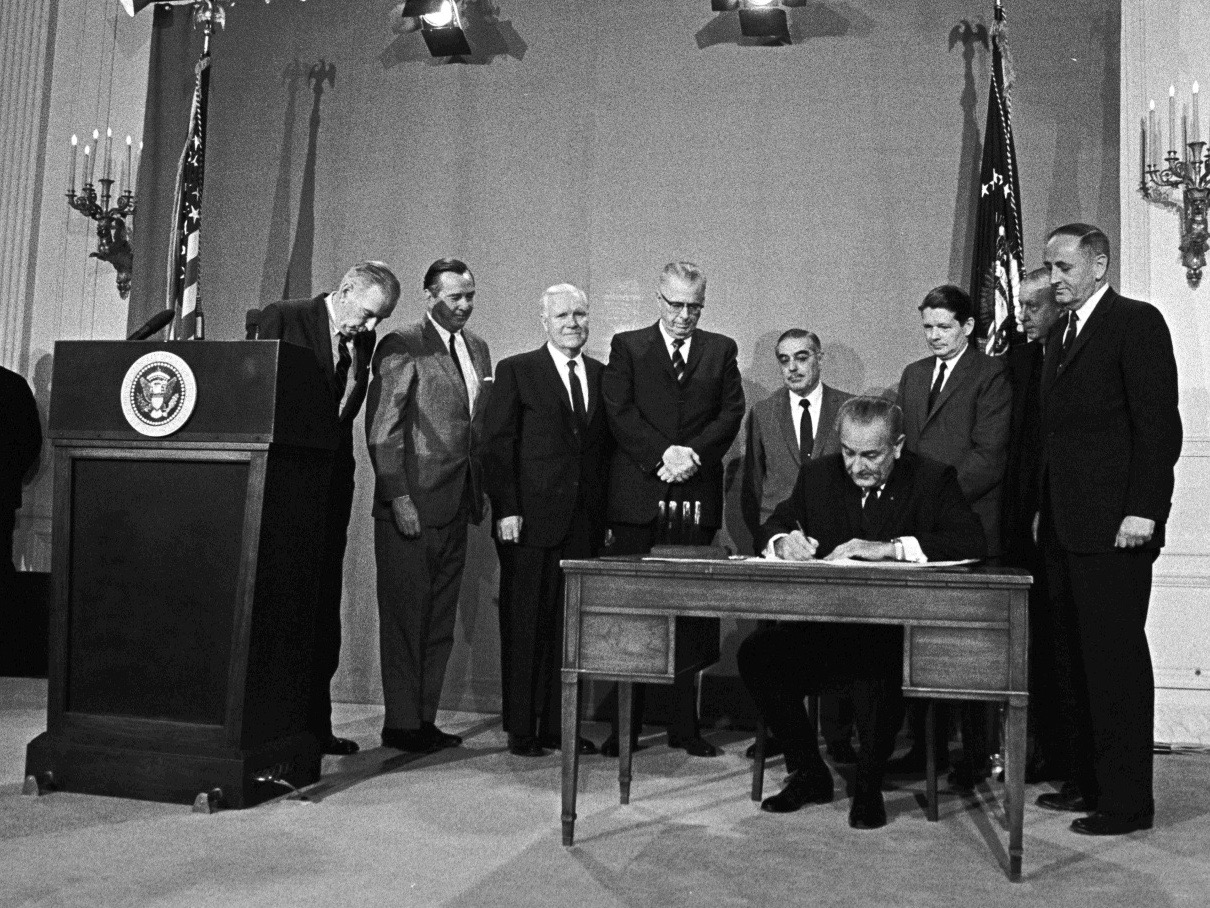
When Congress adopted the Public Broadcasting Act 40 years go, it put its contribution to public TV and radio into the hands ...President Johnson’s remarks on signing the Public Broadcasting Act, 1967
In LBJ's 1967 speech endorsing public broadcasting, he says he has asked his advisers "to begin to explore the possibility of a ...Wilbur Mills to LBJ: ‘We ain’t gonna give money to folks without some strings attached’
Congress doesn’t work that way, said Wilbur Mills, the formidable chair of the House Ways and Means Committee in the late 1960s. ...









Current is an editorially independent, nonprofit service of the American University School of Communication. We're funded by your subscriptions, your donations, advertising, and a generous grant from the Wyncote Foundation.